On the bending line, slumping comes down to the thermal profile. If the heat is sluggish, uneven, or drifting, you’ll see shape deviation, optical distortion, and thermal stress that shows up later as breakage. Convection ovens drag out cycle time, and radiant panels tend to leave hot and cold zones across the mold. We built an infrared lamp for glass slumping to put control back where it belongs—right in the process.
What matters, technically
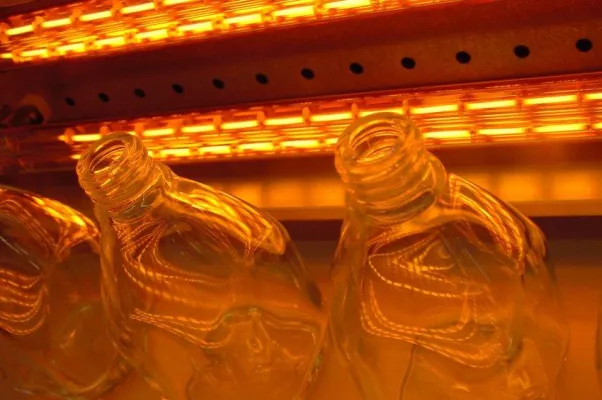
We’re using short-wave infrared with a quartz envelope to put energy straight into the glass surface, without wasting time heating the air around it. The response is near-instant, and each module can be tuned from 1.5 kW to 6.0 kW, with 240 V or 480 V configurations to match your plant power. The filament layout and reflector geometry are worked out so the thermal field is uniform across the slumping zone, which cuts down the gradients that drive warp and stress. Peak wavelength stays in the NIR band, so heat penetrates fast and couples efficiently into the glass, while the lamp stays compact enough to fit into tight spots.
Why it works in practice
In slumping, you need repeatable temperature control so every part hits the same sag profile. This lamp reaches setpoint faster than conventional heating, so you can shorten dwell and push throughput. Because the heat is directional and localized, the mold and tooling stay cooler, which means less thermal drift and longer service life. The payoff is fewer reworks, tighter radius control, and less scrap from optical distortion. And the same approach carries over—bending, tempering preheat, coating drying, even lamination preheat—so you can standardize heating behavior across multiple lines.
What to keep in mind
Installation is straightforward, but line-of-sight is non-negotiable. The lamp has to see the glass surface cleanly; any obstruction throws shadows and makes heating uneven. Keep the target distance within the specified range, and confirm emissivity on coated surfaces, because coatings absorb differently. Give the system a warm-up window before it settles, and plan routine cleaning of the quartz and reflector if you run in a dusty environment. For the cleanest results, pair the lamp with a calibrated pyrometer and closed-loop control to hold temperature within ±3 °C through the cycle.